I really tried to do well in this term. You could say I succeeded...
I did well with surface area and volume this term because if you compared them to the rest of the endless topics in math, they’re relatively easy. In the “greatest volume test”, I got 19 out of 19 correct (or was it 18?). I kind of struggled with tax at first, but I got the hang of it fairly quickly. I'll do better next term by checking my work on tests so I won’t make any stupid mistakes and also making sure I do all of my homework.
I learned a lot during the percent unit. I learned how to calculate taxes, handle fees, and most of all, how to make a 5-minute math video (6, really) with about a dozen people watching you... awkwardly...
The surface area unit was pretty easy. The formulas were simple and easy to learn and you only needed three of them (not including the half a dozen cylinder formulas). The only problem you really run into is the lack of looseleaf that ensues after drawing about 30 nets.
Volume was the easiest of the three. Just three formulas, a pencil, and a calculator away from actually acing a test. Of course, if you don’t screw up multiple choice, your cubic units, your cubic units... if you check your work really good, you should be fine.
In this term, I did really well on the tests, but I didn’t do absolutely all of my work.
In the next term, I will try to do all of my work as well as keeping the test marks up.
*Audioboo to come*... hopefully...
Showing posts with label meldrick73. Show all posts
Showing posts with label meldrick73. Show all posts
Thursday, March 17, 2011

Monday, March 7, 2011
Meldrick's Great Big Book of Integers
Chapter 1
Grade 7 integer questions are written like this -


Grade 7 Integer Review
Integers can be represented by-
number lines
OR
integer chips
Integers are any positive or negative whole numbers - 0 is also an integer even it isn't positive or negative.
When a positive integer and a negative integer of the same value are put together, they form a zero pair - the value of any number of zero pairs is zero.
Here is a useful song to remember -
♪ when subtracting something that isn't there, use a zero pair♪
Grade 7 integer questions are written like this -
(+4)+(-4)
Standard form (grade 9) integer questions are written like this -
4-4
-3 - (-7)

-3 - 7

3 - 7

3 + 7


Chapter 2
Multiplying Integers
The sign rule says that if you are multiplying or dividing integers, you multiply/divide first, then count the amount of negative signs. If the amount is even, the product/quotient will be positive. If the amount is odd, the product/quotient will be negative.
(+2)*(+3)

(+2)*(-3)

(-2)*(+3)

(-2)*(-3)

Chapter 3
Dividing Integers
Partative division is when you make groups of your total to get your answer. It is usually shown on a number line.
Quotative division is when you share your total with groups. However, not all integer questions can be represented by quotative division... yet.
You can also use multiplicative inverse to get the quotient of a division question -
6/(-2) = -3
(-3)*(-2) = 6
(-2)*(-3) = 6
If you remember the sign rule earlier, you can solve these questions -
6/2 = 3
*there are no negative signs - the answer is positive*
-6/(-2) = 3
*there is an even number of negative signs - the answer is positive*
-6/2 = -3
*there is an odd number of negative signs - the answer is negative*
6/-2 = -3
*there is an odd number of negative signs - the answer is negative*
Chapter 4
Order of Operations
Do you remember BEDMAS? If not...
Brackets
Exponents
Division
Multiplication
Addition
Subtraction
Not that you will ever see exponents in an integer question... but the rest is very important.
EX.
5*3+(-6)/3
You should add square brackets around multiplication and division to help you.
[5*3]+[(-6)/3]
Then solve...
15+[(-6)/3]
15+(-2) = 13
Wednesday, February 2, 2011
Meldrick's Circle Surface Area Post
Here are the notes that we took down in class:


The volume of the triangular prism shown is 48 cm^3. What is the value of the missing measurement?
The value of the missing measurement is 5.
EX.
-the bases of a cylinder are circles
-the radius is half a diameter
-the diameter cuts a circle in half
-the circumference is the perimeter of a circle
-pi - the ratio between the circumference and diameter- 3.14159.. and on.. and on- you get it, right?
Here are the formulas that we also took down in class:
Radius
d/2=r
Diameter
2r=d or c/pi=d
Circumference
pi(d)=c *remember, brackets mean multiplying*
Area (of a circle)
Pi(r squared)
For example:

Here are the homework circles:


Here is a link to a video that I couldn't embed.
7.3

a) When the radius of a cylinder is doubled, the volume of a cylinder is multiplied by 4.
EX.
v = π*r^2*h
v = 3.14*1²*1
v = 3.14*1*1
v = 3.14 cm³
v = π*r^2*h
v = 3.14*2²*1
v = 3.14*4*1
v = 12.56 cm³
b)When the height of a cylinder is doubled, the volume of the cylinder is doubled.
EX.
v = π*r^2*h
v = 3.14*1²*1
v = 3.14*1*1
v = 3.14 cm³
v = π*r^2*h
v = 3.14*1²*2
v = 3.14*1*2
v = 6.28 cm³
7.4
7.3

a) When the radius of a cylinder is doubled, the volume of a cylinder is multiplied by 4.
EX.
v = π*r^2*h
v = 3.14*1²*1
v = 3.14*1*1
v = 3.14 cm³
v = π*r^2*h
v = 3.14*2²*1
v = 3.14*4*1
v = 12.56 cm³
b)When the height of a cylinder is doubled, the volume of the cylinder is doubled.
EX.
v = π*r^2*h
v = 3.14*1²*1
v = 3.14*1*1
v = 3.14 cm³
v = π*r^2*h
v = 3.14*1²*2
v = 3.14*1*2
v = 6.28 cm³
7.4

The volume of the triangular prism shown is 48 cm^3. What is the value of the missing measurement?
The value of the missing measurement is 5.
EX.
[v/h²]*2 = area of the base
[48 cm³/8 cm]*2 = area of the base
6 cm²*2 = area of the base
12 cm² = area of the base
area of the base/h¹ = base
area of the base/h¹ = base
12 cm²/4 cm = base
3 cm = base
Now, if...
h¹ = a
base = b
■ = c
a²+b² = c²
4²+3² = c²
16+9 = c²
25 cm² = c²
sqrt of c² = c
sqrt of 25 = c
5 = c
5 = ■
Sunday, January 16, 2011
Final Percent Post
A percent is a fraction out of one hundred. It can be represented by a hundred grid and written as fractions and decimals. You can use percents to find part of an amount of money, to be used for taxes or discounts.
This chapter was about percents and how to use them in real life to solve many of the problems in ... well, real life.
You can represent percents using a hundred grid - 4.1
1 grid = 100%

This grid shows 50%
Percents can also be written as fractions and decimals - 4.2
50% = 1/2 = 0.5
To calculate the percent of a number, write the percent as a decimal and multiply it by the number - 4.3
50% of 100 = 0.5 x 100
50% of 100 = 50
To calculate the increase in a number - 4.4
Here is my link to a website that helps you with percents.
This chapter was about percents and how to use them in real life to solve many of the problems in ... well, real life.
You can represent percents using a hundred grid - 4.1
1 grid = 100%

This grid shows 50%
Percents can also be written as fractions and decimals - 4.2
50% = 1/2 = 0.5
To calculate the percent of a number, write the percent as a decimal and multiply it by the number - 4.3
50% of 100 = 0.5 x 100
50% of 100 = 50
To calculate the increase in a number - 4.4
- You can add the combined percent amount to the number original number-
12% of 100 = 0.12 x 100 = 12
100 + 12 = 112
- You can multiply the original number by a single percent greater than 100-
112% of 100 = 1.12 x 100
112% of 100 = 112
Here is my video:
Here is my link to a website that helps you with percents.
Tuesday, December 21, 2010
Meldrick's Pay It Forward
Part 1
'Pay it Foward' is a movie about an 11-year old boy named Trevor. He gets a Social Studies assignment that says he must 'make a plan to change the world and put it into action'. He comes up with the idea of 'Paying it Forward.' If he helps 3 people and tells them to pay it forward, each of them help another three people, and another three people, and so on. The number of people helped gets really big. Trevor helps three people; a drunk who ends up saving a woman's life; his Social Studies teacher, who gets married to his mom; and a kid who is bullied a lot. Unfortunately, one of the bullies stabs Trevor, and Trevor dies (sadly).
Part 2
My act of kindness was to send a letter to a Canadian soldier. I wanted to send a care package, my mom told me to write a letter instead. I chose this activity because it's sad to think that you have to serve the army and be away from your family on Christmas. I think it's really important to show that someone cares for them. I helped a random Canadian soldier by sending them a letter. I e-mailed a letter to an e-mail address that would send the letter for me, as well as composing a letter to be mailed to a PO box. I did this on Tuesday, December 21st.
Part 3
My act of kindness went really well. I managed to send two letters online to soldiers in Afghanistan. I still have to mail the letter to the PO box. I felt really good to help a Canadian soldier with the fact that they would not be home for Christmas. I couldn't ask the soldier to pay it forward because they do that every day, serving the country and the thousands of people who live in it.
Part 4
The idea of paying it forward is important because there are always people to help, and helping another person means helping the world become a much better place to live in. I do think my act of kindness made a difference in the world, because with one Canadian soldier feeling better about serving the armed forces, it makes them all prouder to serve their country and to make the world a better place.
'Pay it Foward' is a movie about an 11-year old boy named Trevor. He gets a Social Studies assignment that says he must 'make a plan to change the world and put it into action'. He comes up with the idea of 'Paying it Forward.' If he helps 3 people and tells them to pay it forward, each of them help another three people, and another three people, and so on. The number of people helped gets really big. Trevor helps three people; a drunk who ends up saving a woman's life; his Social Studies teacher, who gets married to his mom; and a kid who is bullied a lot. Unfortunately, one of the bullies stabs Trevor, and Trevor dies (sadly).
Part 2
My act of kindness was to send a letter to a Canadian soldier. I wanted to send a care package, my mom told me to write a letter instead. I chose this activity because it's sad to think that you have to serve the army and be away from your family on Christmas. I think it's really important to show that someone cares for them. I helped a random Canadian soldier by sending them a letter. I e-mailed a letter to an e-mail address that would send the letter for me, as well as composing a letter to be mailed to a PO box. I did this on Tuesday, December 21st.
Part 3
My act of kindness went really well. I managed to send two letters online to soldiers in Afghanistan. I still have to mail the letter to the PO box. I felt really good to help a Canadian soldier with the fact that they would not be home for Christmas. I couldn't ask the soldier to pay it forward because they do that every day, serving the country and the thousands of people who live in it.
Part 4
The idea of paying it forward is important because there are always people to help, and helping another person means helping the world become a much better place to live in. I do think my act of kindness made a difference in the world, because with one Canadian soldier feeling better about serving the armed forces, it makes them all prouder to serve their country and to make the world a better place.
Tuesday, November 16, 2010
Meldrick's Textbook Pages
The pages I had to do 7, 10, 13, and the deadly question 16.



Now, imagine that the triangle has been cut in half, from the top right corner to the bottom left corner, so that the diagonal is on a 'flat surface'. Using the height (5mm) and length (12mm), we can find the hypotenuse of the 'triangle' that was created when the rectangle was cut in half, using the Pythagorean theorem (height-a, length-b):
Hopefully, you found that helpful. Good night (it's 1:05 AM), and goodbye.
Number 7
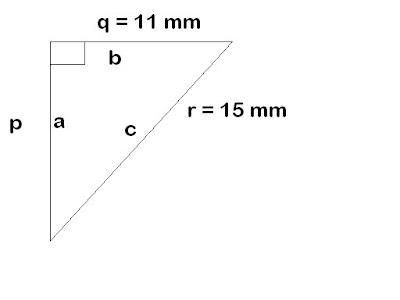
What is the missing length of the leg for each triangle? Give your answer to the nearest tenth of a millimetre.
a)

a²+b²=c²
a²+5²=9²
a²+(5x5)=(9x9)
a²+25-25=81-25
a²=56 mm²
√a²=√56 mm²
√a²=√56 mm²
a=7.5 mm
b)
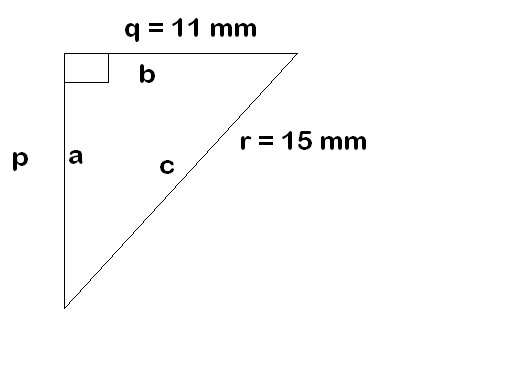
a²+b²=c²
a²+11²=15²
a²+(11x11)=(15x15)
a²+121-121=225-121
a²=104 mm²
√a²=√104
a=10.2 mm
Number 10
What is the minimum distance the player at third base has to throw to get the runner out at first base? Express your answer to the nearest tenth of a metre.

a²+b²=c²
27²+27²=c²
(27x27)+(27x27)=c²
729m²+729m²=c²
1458m²=c²
√1458=√c²
38.2m=c
The player must throw a distance of 38.2 metres.
Number 13
Determine the length of the base of the large triangle. Express your answer to the nearest tenth of a millimetre.

a²+b²=c²
8²+b²=10²
8²+b²=10²
(8x8)+b²=(10x10)
64-64+b²=100-64
64-64+b²=100-64
b²=36mm²
√b²=√36
b=6mm
b(2)=6(2)
Base=12cm
Number 16
The deadly number 16. Hopefully you won't need this guide, as it is for people who have been reduced to tears (not literally) by this question. But if you are one of these people, you are welcome to look at the answer.
What is the length of the red diagonal in the box? Express your answer to the nearest tenth of a millimetre.

Now, imagine that the triangle has been cut in half, from the top right corner to the bottom left corner, so that the diagonal is on a 'flat surface'. Using the height (5mm) and length (12mm), we can find the hypotenuse of the 'triangle' that was created when the rectangle was cut in half, using the Pythagorean theorem (height-a, length-b):
a²+b²=c²
5²+12²=c²
(5x5)+(12x12)=c²
25+144=c²
169cm²=c²
√169=√c²
13mm=c
After that, imagine turning the triangle so that you can see the red diagonal cutting a rectangle in half. You have already found the bottom of the rectangle (13mm), and you have the measurements for the right side of the rectangle, the width (7mm). Using the Pythagorean theorem, you can now find the red diagonal (width-a, bottom-b).
a²+b²=c²After that, imagine turning the triangle so that you can see the red diagonal cutting a rectangle in half. You have already found the bottom of the rectangle (13mm), and you have the measurements for the right side of the rectangle, the width (7mm). Using the Pythagorean theorem, you can now find the red diagonal (width-a, bottom-b).
7²+13²=c²
(7x7)+(13x13)=c²
49+169=c²
218cm²=c²
√218=√c²
14.8cm=c
Hopefully, you found that helpful. Good night (it's 1:05 AM), and goodbye.
Sunday, October 24, 2010
Meldrick's Square Numbers Post
Square Numbers and Square Roots
Focus On

Focus On
- determine the square of a whole number
- determine the square root of a perfect square
- is the product of the same two numbers; 3 x 3 = 9, so 9 is a square number.
- is also known as a perfect square; a number that is not a perfect square is called a non perfect square.

Homework:
- the perfect square chart
That is all... remember to comment!
Sunday, October 17, 2010
Meldrick's Sesame Street Post
Members:
Maya, who is Elmo, then Alfred in the blooper reel;
Ana, who is Zoe, then Alfred in the blooper reel;
Me, who is Alfred, then Zoe in the blooper reel;
Anabelle, the merciful person who let us use her house, is Elmo in the blooper reel.
Definitions:
Two-Term Ratio: a comparison of 2 different things measured in different units.
players:spectators
1:5
Three term Ratio: a comparison of 3 different things measured in different units.
ball:players:spectators
1 : 12 : 60
Rate: a comparison of 2 different things measured in different units.
60km/h is a rate.
Unit Rate: a rate in which the second term is one.
72 beats/min is a unit rate.
Proportion: a relationship that says two ratios or rates are equal.
/2
balls 2 1
----------- = ---------- -----------
players 24 12
/2
Maya, who is Elmo, then Alfred in the blooper reel;
Ana, who is Zoe, then Alfred in the blooper reel;
Me, who is Alfred, then Zoe in the blooper reel;
Anabelle, the merciful person who let us use her house, is Elmo in the blooper reel.
Definitions:
Two-Term Ratio: a comparison of 2 different things measured in different units.
players:spectators
1:5
Three term Ratio: a comparison of 3 different things measured in different units.
ball:players:spectators
1 : 12 : 60
Rate: a comparison of 2 different things measured in different units.
60km/h is a rate.
Unit Rate: a rate in which the second term is one.
72 beats/min is a unit rate.
Proportion: a relationship that says two ratios or rates are equal.
/2
balls 2 1
----------- = ---------- -----------
players 24 12
/2
Monday, October 4, 2010
Meldrick's Math Profile
Hello, my name is Meldrick Agravante and I'm a student in Grade 8 Math. If someone asked me if I liked math, I'd say "Yes, yes I do". The best thing I ever did in a math class was an activity of showing how the area of a circle and a parallelogram are similar using an orange, because we got to eat the orange afterwards (thank you Ms. Wilson).
In Grade 7, the best unit I studied was two-step equations and I found it easy because I studied it the year before in Grade 7. The worst unit I studied was integers because I found it tedious to draw the number lines and integer chips. I could improve this year by sucking it up and drawing the cursed lines and chips.
To be a better math student in Grade 8 than I was in Grade 7, I will try to do work faster and not do it at the last minute like I usually do (like now). One thing I'd like to learn this year would be how to use those complicated buttons on the calculator that don't seem to make any sense at all.
My favourite post that I made was my last one, How to Scribe, because I put a picture of Elmo, linked it to my favourite book series' website, and added an Adam Lambert music video, Whattaya Want From Me. Blogging helped me with math by helping me get caught up when I was away and also making math a little more entertaining. This year, I'd like to keep blogging and adding lots of videos to our posts, at least one math related and one music video.
In Grade 7, the best unit I studied was two-step equations and I found it easy because I studied it the year before in Grade 7. The worst unit I studied was integers because I found it tedious to draw the number lines and integer chips. I could improve this year by sucking it up and drawing the cursed lines and chips.
To be a better math student in Grade 8 than I was in Grade 7, I will try to do work faster and not do it at the last minute like I usually do (like now). One thing I'd like to learn this year would be how to use those complicated buttons on the calculator that don't seem to make any sense at all.
My favourite post that I made was my last one, How to Scribe, because I put a picture of Elmo, linked it to my favourite book series' website, and added an Adam Lambert music video, Whattaya Want From Me. Blogging helped me with math by helping me get caught up when I was away and also making math a little more entertaining. This year, I'd like to keep blogging and adding lots of videos to our posts, at least one math related and one music video.
Subscribe to:
Comments (Atom)