Showing posts with label "Great Big book of Integers". Show all posts

Friday, March 25, 2011

Olivia's Great Big Book of Integers

Chapter 1
Grade 7 Integer Review
Integers can be represented with a number lines or integer chips.

integers are usualy represented with two colors red and blueNegative - Blue
Positive - Red

Zero Pairs - a pair of negative and positive numbers and the sum is zero.

ex. (-3) + (+3) = 0.
This is a rhyme you should sing to yourself during a test if you can't remember when to use a zero pair.
When subtracting something that isnt there, use a zero pair.

In grade 7 we did integers like this
(-3)+(+7)= the thing about doing integer in grade 7 is there is brackets.

Here are some questions:

13. a)(+4)x(+6)=24
d)( -8)x(-2)=16

Chapter 2
multiplying integers

Here are some questions we did.
10. a(17)x(-24)= -408
b(34)x(22)=56

For a multyplycation question that needs a zero pair you can see how many zero pairs you need by multiplying the two factors in the question without their negative or positive signs.

ex. (-2) x (+3) - 2 x 3 = 6

chapter 3
Dividing Integers

Partative Division or groups of, If you know the number of groups, but you dont know the number in each group then that is partative division.

1.6÷2=3
6 groups of 2

2. 3÷2=1.5
3 groups of 2

Quotative Division

If you know the number that is in each group, but you dont know the number of groups then that is quotative division.

1.(-6)÷(2)= -3

another way to mutiply intgers is multiplicated-inverse

-2÷-3
-3÷-2

-In a division question with an even amount or no (-) signs the quotient will be positive.
-In a divison question with an odd amount of negative signs the quotient will be negative

Chapter 4

Order of operation with integers

(+5) x (-3) + (-6) / (+3) =

To do order of opration u won't to follow the rules of B.E.D.M.A.S. Brackets, Exponents( except there are no exponents in bedmas) , Division, Multiplication, Addition, Subtraction.

First add square brackets around the expressions with a x or / to help remind you to answer them first. The square brackets means that you should answer the question in them before doing anything else.

1.-6-9+10-1= -6

Thursday, March 24, 2011

Joshua's Great Big Book Of Integers

Chapter 1

Grade 7 Integer Review
Integers can be represented with number lines or integer chips.

Negative - Blue
Positive - Red


Zero Pairs - a pair of negative and positive numbers whose sum is 0.

ex. (-8) + (+8) = 0.
This song will help you remember when to use a zero pair:
When subtracting something that isnt there, use a zero pair.

This is how we did integers in Grade 7.


Here are some questions we did.

Chapter 2

Multiplying Integers

Here we learned how to multiply integers. Here are some questions we did.


For questions needing a zero pair you can find out how many zero pairs you need by multiplying the two factors in the question without their negative or positive signs.

ex. (-2) x (+3) - 2 x 3 = 6

6 zero pairs

Chapter 3

Dividing Integers

Partative Division or groups of

If you know the number of groups, but you dont know the number in each group then that is partative division.


Quotative Division

If you know the number that is in each group, but you dont know the number of groups then that is quotative division.


You could also find the answer to a division question using multiplicated-inverse

In a division question with an even amount or no (-) signs the quotient will be positive.
In a divison question with an odd amount of negative signs the quotient will be negative.

Chapter 4

Order of Operations with Integers


(+5) x (-3) + (-6) / (+3) =

To answer this question you will need to folow the rules of B.E.D.M.A.S. Brackets, Exponents, Division, Multiplication, Addition, Subtraction.

First add square brackets around the expressions with a x or / to help remind you to answer them first. The square brackets means that you should answer the question in them before doing anything else.


Tuesday, March 22, 2011

Summer's Great Big Book Of Intergers

Chapter one: Grade 7 integers review

Integers
- number line
- integer chips
- zero pair


- negative and positive numbers

Integers


- Number line


Song:
"When subtracting something that isn't there use a zero pair"


Find the zero pairs for the following integers

-6 +10 -16 63
+6 -10 +16 -63


-11 +11

+ 14 -14

19 -19


integers Ala grade 7

have 4 owe 4
(+4) + (-4) = O

Brackets are training wheels.
Standard form:

+4 + -4
+4 -4

pure standard form:
4 -4


3 -2 = Subtraction = adding a negative integer.


Questions:

-3 - (-7) = -10

-3 - 7 = 10

3 - 7 = -4

3 + 7 = 10

-3 + 7 = 4


Chapter 2 multiplying integers:

multiplying integers:

(+2) x (+3) = +6

(2) x (3) = 6

(2) (3) = 6 2 (3) = 6
standard form


(=2) x (+3) = 6

or

2 groups of ( +3) = 6


( +2) x (-3) = -6

or

2 groups of (-3) = -6


(-2) x (+3)

(+3) x (-2) = -6

remove 2 groups of (+3)
(use zero pairs)


( -2) x (-3)
remove 2 groups of (-3) = +6


(-3) x (-4) = + 12


(+2) x (+4) = +8

(+5) x (-2) = -10

(+4) x (+2) = -8 - 4 x 2 for zero pairs remove (+) left with (-)

(-6) x (-1) = -6


Sign Rule: (negative signs)

Even: when you have an even number of negative factors the product is positive.

Odd: when you have an odd number of negative factors the product is negative.


Chapter 3 dividing integers:

Partitive division using a number line:

6 / 2 =


-6 / (-2) =


Quatative Division:

(-6) / 2 = -3


Multiplicative Inverse:

6 / (-2) = 4

Sign Rule for Division: using

6 / 2 = 3

-6 / (-2) = -4

(-6) + 2 = -4

6 / (-2) = 4


Chapter 4 order of operations with integers:

explain how to solve this:

(+5) x (-3) + (-6) / (+3) =

[(+5) x (-3)] + [(-6) / (+3)] =

-8 + -17 = -25

first add extra brackets then do the problems that are inside the extra brackets then add the two numbers that came from the extra brackets together and you have your answer.

Sunday, March 20, 2011

Breanna's Great Big Book of Integers

Chapter 1:
Adding and Subtracting Integers
-6-(-4)= (-2)
-10+6= (-4)
6-7+2= 1
14- (-3)= 17

-3-(-7)= 4


-3-7= (-10)


Chapter 2:
Multiplying Intergers

Examples:
(+3)x(+2)= 3 groups of 2
repeated addition
2+2+2= +6
two groups of +3
(2)x (+3)=

Questions
(+2)x(+3)= +6
2 groups of (+3)Add Image


(-2)x(+3)= -6


Sign Rules

Even- When you have an even number of negative factors the product is positive.
Odd- When you have an odd number of negative factors the product is negative

Chapter 3:
Dividing Integers

Partitive Division is when you use groups of to get to your quotient.

6/2=3


(-6)/(-2)= +3


(-6)/2= (-3)


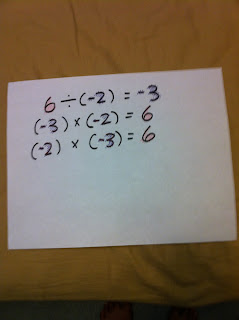
Multiplicative Inverse is when you use multiplication to figure out your quotient.
6/(-2)=
(-2)x(-3)=6
(-3)x(-2)=6
Means 6/(-2)=(-3)

Sign Rules

In a divison question with an even amount or no negative signs the quotient will be positive.
example: 6/2=3
(-6)/(-2)=3

In a divison question with an odd number of negative signs the quotient will be negative.
example (-6)/2=3
6/(-2)= (-3)

Chapter 4
Order of Operations with Intergers

(+5)x(-3) + (-6)/(+3)=

Scince there are no square brackets or exponents we should start with division and multiplication going from left to right.


[(+5) x (-3)] +[(-6)/(+3)]=
(-15)=(-2)=

After your done with division and multiplication you should do the addition
(-15)+(-2)=(-17)

Friday, March 11, 2011

Ana Lopena's Great Big Book Of Intergers

Chapter 1

Grade 7 Integer Review

Integers can be represented with number lines or integer chips.
negative- blue
positive - red

zero pairs- a pair of negative and positive numbers whose sum is 0.
ex. (-8) + (+8) = 0, (-20) + (+20) = 0
Here is a song to help you remember when to use a zero pair- *When subtracting something that isn't there use a zero pair!*

This is how we wrote integers in grade seven

Here are some questions that we did.


Chapter 2

Multiplying Integers

Here we learned how to multiply integers, here are some questions that we did.


For questions needing a zero pair you can find out how many zero pairs you need by multiplying the two factors in the question without their negative or positive signs.
ex. (-2) x (+3) - 2 x 3 = 6
6 zero pairs


Chapter 3

Dividing Integers

Partitive Division or Groups of
If you know the number of groups, but you don't know the number in each group then that is partitive division.


Quotative Division

If you know the number that is in each group, but you don't know the number of groups then that is quotative division.


You can also find the answer to a division question using multiplicated inverse-

In a division question with an even amount or no (-) signs the quotient will be positive.
In a division question with an odd number of negative signs the quotient will be negative.


Chapter 4

Order of Operations with Integers

(+5) x (-3) + (-6) ÷ (+3)=

To answer this question you will need to follow the rules of B.E.D.M.A.S.
Brackets, Exponents, Division, Multiplication, Adding, Subtracting

First add square brackets around the expressions with a x or ÷ to help remind you to answer them first. The square brackets means that you should answer the question in them before you do anything else.

Now answer, and write it in a new line on your paper.


Now all that you have to do is answer it.