Chapter 1
Grade 7 Integer Review
Grade 7 Integer Review
Integers can be represented with number lines or integer chips.
Negative - Blue
Positive - Red
Positive - Red
Zero Pairs - a pair of negative and positive numbers whose sum is 0.
ex. (-8) + (+8) = 0.
This song will help you remember when to use a zero pair:
When subtracting something that isnt there, use a zero pair.
This is how we did integers in Grade 7.
When subtracting something that isnt there, use a zero pair.
This is how we did integers in Grade 7.

Here are some questions we did.


 Chapter 2
Multiplying Integers
Here we learned how to multiply integers. Here are some questions we did.

 For questions needing a zero pair you can find out how many zero pairs you need by multiplying the two factors in the question without their negative or positive signs.
ex. (-2) x (+3) - 2 x 3 = 6
6 zero pairs
Chapter 3
Dividing Integers
Partative Division or groups of
If you know the number of groups, but you dont know the number in each group then that is partative division.

Quotative Division
If you know the number that is in each group, but you dont know the number of groups then that is quotative division.

You could also find the answer to a division question using multiplicated-inverse
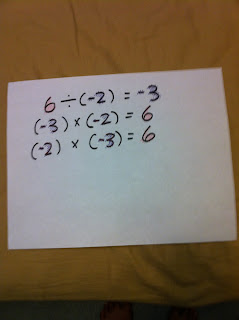 In a division question with an even amount or no (-) signs the quotient will be positive.
In a divison question with an odd amount of negative signs the quotient will be negative.
 Chapter 4
Order of Operations with Integers
(+5) x (-3) + (-6) / (+3) =
To answer this question you will need to folow the rules of B.E.D.M.A.S. Brackets, Exponents, Division, Multiplication, Addition, Subtraction.
First add square brackets around the expressions with a x or / to help remind you to answer them first. The square brackets means that you should answer the question in them before doing anything else.


